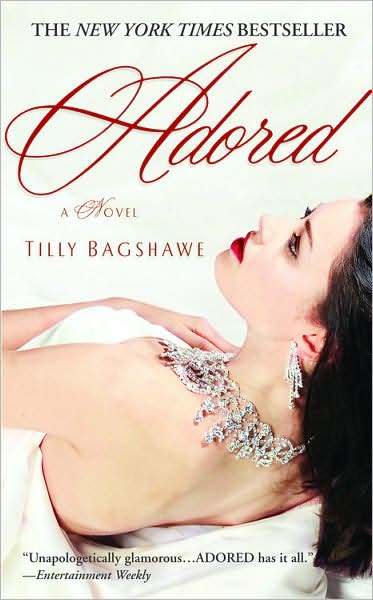
I liked it. It is a self indulgent womens' glamorous fantasy. Who wouldn't
want to feel like the most beautiful woman on earth with all the old
money to be astute, all the new money to be lavish, and all the attitude
to be in control? For 700 pages I experienced owning Armani suits, Louis Viutton luggage, and Hermes scarves. The plot and characterizations were at times subpar, but that didn't take away from the pleasure-of-the-flesh experiences the book so selflessly displayed.
A short summary: Duke McMahon, the cowboy movie star and patriarch,
survives the novel just long enough to demonstrate an especially
glamorous form of cruelty to his wife, Minnie. He moves his mistress in
much to the chagrin of his live-in adult children. Its a long book. A
bunch of stuff happens and it turns out that the book is about Duke's
granddaughter, Siena. She decides that she wants to be a model/actress
even though her dad wants her to be a doctor. He disowns her and she
flails around wildly and 300 pages go by. She eventually meets a wealthy
producer that launches her career and challenges her libido. Spoiler:
he beats her to a bloody pulp and it ruins her face and therefore her
career, driving her back to her family. There is a poorly crafted love
story in there and it ends with a wedding.
There is as lot to say if only because the sheer girth of this novel.
The Duke-Minnie relationship was gold and I wish we could have seen more of it before Duke died. I was endlessly enthralled about the thought process behind Minnie standing it. How on earth could a self respecting woman allow her husband's mistress to move in with them? That is the single defining quality differentiating a wife from a mistress. A wife takes care of house! A mistress takes care of the sex! I draw the line right there.
The Max-Siena relationship, not so much. Max-Siena is the poorly crafted love story that I spoke about earlier. You could tell that the Max-Siena was end game because he saved her life when they were little kids, but it wasn't believable when they were older. They just fell into eachothers arms out of convenience and began a relationship out of hate-born lust. All the sentimentality and tenderness that they reminisced about after the relationship just was never there. And Max crying endlessly afterwards? That just isn't believable.
There was an insufferable B-Story about Max's brother in England having financial troubles severe enough to "lose the farm", literally. The way it was tied up in a knot at the end, how it held an entire cast of supplementary characters, and how it only served as a place for Max to convalesce all qualified as fat that could have been cut right off the top. The book could have easily been 300 pages shorter and a lot less boring.
It is interesting how a book can be a Pulitzer Prize and not a New York
Times best seller. Remember, I am reading this book directly after
reading Swamplandia!, a critically acclaimed novel. Quality is such a
loose word when judging books. This book isn't earth shattering, and I
won't come away with it with an adjusted world view. (Although, maybe I
need to buy a new purse). People buy what their friends buy, and then
they go and buy what ever is on the New York Times bestsellers list. I
just don't think that list is to be trusted to give good books.
Overall, read this book if you
a) are female
b) feel like having a "light read"
c) Simultaneously want to exalt and execute the fabled 1%
Other notes:
- Have you noticed how everyone is either tall and slender or 5'4?
- A 5'4 model? pft, maybe in SPAIN
- Is it just me, or is Max and Hunter two halves of the same person?
- Of course a book that exalts beauty to the extent that it does would have Poor Laurie die a spinster.
- Just because the second to half chapter is written in past tense doesn't mean that the book should be winding down.
Swamplandia! by Karen Russell
Anyway, that's how I got suckered into reading Swamplandia! The first chapter made me immediately regret this decision and I held that disdain for three quarters of the book. It was just so damn depressing.
After the feeling of deep depression wears into a slightly bothersome but waning sadness, you realize that those feelings of unease as a child may have been founded and shared by many forming the new american experience. Swamplandia! captures the quark and texture of offbeat americana. It was refreshing (to some extent) to relive my childhood in this way.
Swamplandia! is about Ava Bigtree, a 13 year old girl following her moms footsteps on becoming a side show act in thier sub par alligator theme park. When her mother dies, the family is torn to pieces. Without the star of the show, the theme park falls in financial ruin. Her brother, Kiwi, runs away to work on a lame rival theme park to raise money to send home. Her older sister, Osceola, dives deeper into a fantasy world where she is dating a ghost. (Here are the spoilers). Her sister casts herself away on a boat to marry one of her ghost friends like a lunatic, and Ava can't stand to be abandoned. She enlists a creepy bird contractor that she affectionately calls "Bird Man" to help her find her sister. He rapes Ava. (end spoilers) Then everything turns out okay.
Ava is weaves in and out of innocence. Those drastic demarcations of naivity is what make this book a gem. It is hard to quantify what maturity is, what makes one act like adult. When you read those small shifts in Ava's mindset, the cross over hit you like a brick wall. She is at one point trying to save the park, then she is trying to save her sister, then she is just trying to save herself by just a small drink of water. She makes mental trade offs between drinking water and realigning with her rapist. She thinks about whether or not she believes in ghosts, and if it even matters what she thinks. I suppose that is what makes a book a "coming of age" story.
I have a theory about the red alligator. The red alligator was Ava's scheme to save the park. She found it while she was harvesting hatchlings, and kept it as a pet. For some odd reason that she can't even explain to herself, she took it with her when she went with the Bird Man to rescue Osceola. After the raping, Ava decides to run and deflects Bird Man's attention by throwing the red alligator hatchling at him. I think the red alligator represented naive hope.
It is clear how childish Ava is being when you see the hard reality at the end of the book. Osceola was sick, and they gave her drugs for it. They could never save the park, and it wasn't the end of the world.
I can see why this book was nominated for a Pulitzer. The writing is hypnotically textured like a Tom Robbins novel without the randomness, with a weighty nostalgia ala Steinbeck. It just wasn't a page turner. I didn't have the urge to come home every day and open this book like I did with The Hunger Games or even like 50 Shades of Grey. There is some unquantifiable quality that makes a book a best seller and its not the same quality that makes it a fine piece of fiction.
Labels:
Fiction,
Reviews by Maria
Cannery Row by John Steinbeck
Its hard to say what this book is about. Laconically, group of adults throw two parties for their friend, Doc. Doc shows up to one of the parties.
The reason most people don't talk about what the book is about is because it doesn't matter what the book is about. It is not supposed to make you think. The whole book is a sensory experience. It was grand and irresponsible and tragic and it made my entire life feel fake. That is a massive feat. This piece of fiction made my real life seem fake.
While I was sitting around thinking very seriously about whether or not I should peruse a masters degree, the people in this book were actually living. I did my nails and pondered taking a nap while the people in this book made mistakes and had regrets and never forget this moment until they died. My life is nothing in comparison, or perhaps it is. Perhaps even the smallest things make my life real. I don't know.
What a piece of art. I feel as though my ability to review this is limited by my failure to be an expert in literature. (Disclaimer: I'm not a literary expert). Cannery Row was a fishing community with people from all walks of life. While some people sat by the bar wondering what sort of hijinks his friends are getting him into, a child fails to understand grief over this father's suicide. And its not such a big deal. The moments of extreme happiness were punctuated by overtly simple tragedy.
All the characters had their moments. Even though Doc tolerated everyone so much, he still punched Mack when he was angry. Mack wasn't responsible enough to see through his actions, but he knew when he deserved a punch in the face. Eddie tap danced in the office alone because he was so excited about the party. The dog got tired of peeing on the floor and house broke himself. It was those little moments that built up a life.
I can't make any grand statements about recommending this book. All people could either read it or not read it. You would come away with something, though. People that read these stories share a collective history and reminisce in the same way. Reading Steinbeck is like remembering that you are apart of a family and a community where every person matters.
Other Notes
Everyone who found out I was reading Cannery Row this week asked me if I've been to the Steinbeck Museum up near Monterey. I think its odd that people are so interested in the real lives of authors. I personally am not. I figure that even if I met Steinbeck himself I wouldn't get the awe and grandeur of reading one of his novels. Certainly I wouldn't get this elated romanticism from looking at his desk. A novel is a condensed version of all the wonderful thoughts that authors have to contribute. And that's good enough for me.
The reason most people don't talk about what the book is about is because it doesn't matter what the book is about. It is not supposed to make you think. The whole book is a sensory experience. It was grand and irresponsible and tragic and it made my entire life feel fake. That is a massive feat. This piece of fiction made my real life seem fake.
While I was sitting around thinking very seriously about whether or not I should peruse a masters degree, the people in this book were actually living. I did my nails and pondered taking a nap while the people in this book made mistakes and had regrets and never forget this moment until they died. My life is nothing in comparison, or perhaps it is. Perhaps even the smallest things make my life real. I don't know.
What a piece of art. I feel as though my ability to review this is limited by my failure to be an expert in literature. (Disclaimer: I'm not a literary expert). Cannery Row was a fishing community with people from all walks of life. While some people sat by the bar wondering what sort of hijinks his friends are getting him into, a child fails to understand grief over this father's suicide. And its not such a big deal. The moments of extreme happiness were punctuated by overtly simple tragedy.
All the characters had their moments. Even though Doc tolerated everyone so much, he still punched Mack when he was angry. Mack wasn't responsible enough to see through his actions, but he knew when he deserved a punch in the face. Eddie tap danced in the office alone because he was so excited about the party. The dog got tired of peeing on the floor and house broke himself. It was those little moments that built up a life.
I can't make any grand statements about recommending this book. All people could either read it or not read it. You would come away with something, though. People that read these stories share a collective history and reminisce in the same way. Reading Steinbeck is like remembering that you are apart of a family and a community where every person matters.
Other Notes
Everyone who found out I was reading Cannery Row this week asked me if I've been to the Steinbeck Museum up near Monterey. I think its odd that people are so interested in the real lives of authors. I personally am not. I figure that even if I met Steinbeck himself I wouldn't get the awe and grandeur of reading one of his novels. Certainly I wouldn't get this elated romanticism from looking at his desk. A novel is a condensed version of all the wonderful thoughts that authors have to contribute. And that's good enough for me.
Labels:
Classics,
Fiction,
Reviews by Maria
Fifty Shades of Grey by E.L James
I can't say that I enjoyed this book. That being said, I read the whole thing in 2 days.
Fifty Shades of Grey is about a young virgin new grad meeting a powerful and handsome entrepreneur. She is delighted to begin a sexual relationship with him only to find that his BDSM sexual predilections frighten and confuse her. She is willing to partake because its the only way they can be together. At the end, she decides that she feels shortchanged and walks away.
That was an extremely sparse summary. I have ready many other reviews about this book and a surprising majority do not summarize the plot line. That is because one doesn't come to this book for the suspenseful plot line (except for perhaps the climax, har har). People come to this book because it is a novelty in many ways. This book represents a community people who felt overlooked by the publishing community and self published against all odds. Without the internet, fanfiction would never see the light of day. And now, with e-readers becoming a norm, a book birthed out of Twilight fandom can be a #1 New York Times Bestseller. Also, women have massive buying power, and its not common that an undiluted smutty book can be so popular.
For porn, this book is mediocre. I wouldn't say that one could throughougly enjoy this book one handed, persay. For high brow fiction, this book is just as well written as many of the other current best sellers. I was suprised. It is better than what I read of the original Twilight. Ana has a distinct personality and I can understand her actions and her rationale. She compares herself to characters in classical books. She isn't just some girl. Christian Grey is the idolized Adonis, but he is still human. He can be creepy in an old-man sort of way. The characters feel like real people that I am glad that I don't know.
The book ended awkwardly in a way that funnels me into the next book. The climax occured in the last 10 pages with her standing up to him and leaving. It doesn't feel like an end of the relationship. It felt like a brief 2 days of weeping before going back to him type of seperation. The author didn't follow the classical 5 part plot structure, seen below
Other Notes
- They are making a movie. I bet they are going to put so much vanilla frosting on this that its going to come out rated R. I say I am not going to watch it, but I probably will.
- I feel like I understand the motivations behind Twilight now that I've read this. I never understood the plight of Bella Swan before and thought she should just head out with Jacob and let herself be happy. While I think Ana may not have been better off with Jose, I can finally see why Bella was conflicted at least.
- The book ending was not satisfying, as noted in my plot structure argument above. I hate how authors are making trilogies instead of well placed and structured individual books. I noticed this about the transition between the Hunger Game novels as well. This feels like my 6th grade class when I was learning how to start and end paragraphs. We don't just start a new line and indent when the paragraph length looks good on the page, we have to finish our idea first.
I am not going to read the next novel in the trilogy, 50 Shades Darker. Not right away, at least. I am going to shift gears into Stienbeck for next week.
Fifty Shades of Grey is about a young virgin new grad meeting a powerful and handsome entrepreneur. She is delighted to begin a sexual relationship with him only to find that his BDSM sexual predilections frighten and confuse her. She is willing to partake because its the only way they can be together. At the end, she decides that she feels shortchanged and walks away.
That was an extremely sparse summary. I have ready many other reviews about this book and a surprising majority do not summarize the plot line. That is because one doesn't come to this book for the suspenseful plot line (except for perhaps the climax, har har). People come to this book because it is a novelty in many ways. This book represents a community people who felt overlooked by the publishing community and self published against all odds. Without the internet, fanfiction would never see the light of day. And now, with e-readers becoming a norm, a book birthed out of Twilight fandom can be a #1 New York Times Bestseller. Also, women have massive buying power, and its not common that an undiluted smutty book can be so popular.
For porn, this book is mediocre. I wouldn't say that one could throughougly enjoy this book one handed, persay. For high brow fiction, this book is just as well written as many of the other current best sellers. I was suprised. It is better than what I read of the original Twilight. Ana has a distinct personality and I can understand her actions and her rationale. She compares herself to characters in classical books. She isn't just some girl. Christian Grey is the idolized Adonis, but he is still human. He can be creepy in an old-man sort of way. The characters feel like real people that I am glad that I don't know.
The book ended awkwardly in a way that funnels me into the next book. The climax occured in the last 10 pages with her standing up to him and leaving. It doesn't feel like an end of the relationship. It felt like a brief 2 days of weeping before going back to him type of seperation. The author didn't follow the classical 5 part plot structure, seen below
It was more like this
This might not be exactly fair. One can look at the local maximas and minimas of the sprawling contract negotiation as rising and falling plot line, I just do not think this is so. Once you introduce constant hedonistic sex into a story, it edges out all other emotion in a story and the plot just stops to watch the show.
Other Notes
- They are making a movie. I bet they are going to put so much vanilla frosting on this that its going to come out rated R. I say I am not going to watch it, but I probably will.
- I feel like I understand the motivations behind Twilight now that I've read this. I never understood the plight of Bella Swan before and thought she should just head out with Jacob and let herself be happy. While I think Ana may not have been better off with Jose, I can finally see why Bella was conflicted at least.
- The book ending was not satisfying, as noted in my plot structure argument above. I hate how authors are making trilogies instead of well placed and structured individual books. I noticed this about the transition between the Hunger Game novels as well. This feels like my 6th grade class when I was learning how to start and end paragraphs. We don't just start a new line and indent when the paragraph length looks good on the page, we have to finish our idea first.
I am not going to read the next novel in the trilogy, 50 Shades Darker. Not right away, at least. I am going to shift gears into Stienbeck for next week.
Labels:
Fiction,
NYT Bestsellers,
Reviews by Maria
Mockingjay by Suzzane Colins
The third installment of the Hunger Games trilogy follows Katniss Everdeen as she is transformed from a child contestant in a macabre televised death match to a soldier and the face of a rebellion. This book takes a drastically different tone from the first two books. The Hunger Games are a romantic metaphor compared to this militaristic war drama. It gets heavy. This book was needed to spell out any lingering analogies, and the social agenda of the Hunger Games finally comes to light
The tone of this book was different from the first two of the trilogy. Katniss and Peeta are separated in the first half, and the book suffers for it. The book loses a lot of its warmth as the effervescent Peeta is held offscreen and tortured. The Gale-Katniss (Gatniss?) relationship gets room to breath, but it has surprisingly little chemistry for a book for this genre. I just don't believe the love triangle. She was never meant to be with Gale, was she?
On a lighter note, here is a photoshop powered illustration of my favorite scene. Bringing down any aircraft with a bow and arrow is ludicrous to me.
A lot of criticism I am reading about the book is how Collins is talking down to her readers in this book more than the others. I agree with other reviewers that some of the smaller analogies were explained a little too thoroughly. The crazy cat game analogy dragged on excruciatingly long even if it was just a few paragraphs. I had to set the book down for a breather because of that one. Also the Katniss's fathers song was brought up and re-explained time after time like a dead horse. I can see how even young adults can find that level of explanation condescending.
On the other hand, she finally reveals what the symbolism behind the Hunger Games actually are. This throws a wrench in my co-workers insight on the FEMA camps and reality television caused voyeurism. It is about war. She drove the point home by making it clear from the beginning that not even the rebels are the good guys, that Katniss can't trust anyone to be good and pure. President Coin was as cold and as opportunistic as President Snow. That is the whole reason the book was so unpleasant. In war, there is no good guy, and everyone suffers in the end. Collins likens war to the hunger games, in which we watch our children fight eachother to the death for pleasure, and a way to ingrain hatred into our culture.
Other Notes
- I disagree with the LA times book review about Mockingjay settling the love triangle. There was never ever any passion between Katniss, Peeta, and Gale, and Katniss just stayed with who ever stayed around the longest. They DID come to the same conclusion about the strong antiwar undercurrents of this book, however
Trilogy Reviews
Read Review for The Hunger Games (Hunger Game Series #1)
Read Review for Catching Fire (Hunger Games Series #2)
Read Review for Mockingjay (Hunger Games Series #3)
The tone of this book was different from the first two of the trilogy. Katniss and Peeta are separated in the first half, and the book suffers for it. The book loses a lot of its warmth as the effervescent Peeta is held offscreen and tortured. The Gale-Katniss (Gatniss?) relationship gets room to breath, but it has surprisingly little chemistry for a book for this genre. I just don't believe the love triangle. She was never meant to be with Gale, was she?
On a lighter note, here is a photoshop powered illustration of my favorite scene. Bringing down any aircraft with a bow and arrow is ludicrous to me.A lot of criticism I am reading about the book is how Collins is talking down to her readers in this book more than the others. I agree with other reviewers that some of the smaller analogies were explained a little too thoroughly. The crazy cat game analogy dragged on excruciatingly long even if it was just a few paragraphs. I had to set the book down for a breather because of that one. Also the Katniss's fathers song was brought up and re-explained time after time like a dead horse. I can see how even young adults can find that level of explanation condescending.
On the other hand, she finally reveals what the symbolism behind the Hunger Games actually are. This throws a wrench in my co-workers insight on the FEMA camps and reality television caused voyeurism. It is about war. She drove the point home by making it clear from the beginning that not even the rebels are the good guys, that Katniss can't trust anyone to be good and pure. President Coin was as cold and as opportunistic as President Snow. That is the whole reason the book was so unpleasant. In war, there is no good guy, and everyone suffers in the end. Collins likens war to the hunger games, in which we watch our children fight eachother to the death for pleasure, and a way to ingrain hatred into our culture.
Other Notes
- I disagree with the LA times book review about Mockingjay settling the love triangle. There was never ever any passion between Katniss, Peeta, and Gale, and Katniss just stayed with who ever stayed around the longest. They DID come to the same conclusion about the strong antiwar undercurrents of this book, however
Trilogy Reviews
Read Review for The Hunger Games (Hunger Game Series #1)
Read Review for Catching Fire (Hunger Games Series #2)
Read Review for Mockingjay (Hunger Games Series #3)
Labels:
Fiction,
Reviews by Maria,
Science Fiction,
Young Adult
Catching Fire by Suzanne Colins
Catching Fire is the sequel to the Hunger Games by Suzanne Colins. It was nice to read a sequel that wasn't a lame afterthought to the original. I haven't finished the third book in the series yet, but I think a trilogy is a bit of a stretch.
Catching Fire is about the fallout after Katniss and Petta's rebellious win in the 74th hunger games. To their dismay, they find that the 75th Hunger Games will draw from the existing pool of winners, and Katniss and Petta find themselves back in the arena.
The pacing was odd. More than half of the book took place in District 12 and the tension around the love triangle between Katniss, Petta, and Gale. The climax of the book didn't address the love triangle or even the tension caused by the Capitol. It simply marked the end of the second round of Hunger Games. In this respect, I suspect that the third book will act as the second half of this one. I know that there is a lot of pressure for science fiction writers to pump out trilogies, but they shouldn't let the pacing suffer like this.
Being a fan of romance, I fell head over heels by the love triangle. The thing that separates this from Twilight is that Katniss could care less about who she falls in love with. She acts like a distracted 16 year old and fails to understand herself emotionally. She just doesn't grasp the responsibility of not leading these boys on. This characterization is spot on. I am tired of reading books about kids where they act and think like short adults. Katniss will end up with who ever is alive at the end of the day, and this is quite refreshing.
What wasn't as refreshing was how acutely aware I was of the female authorship. I love and support female authors, but I felt like some of her detailing about the characters and the culture were only something women would notice. Sure she mentions food and speech, but she goes into a disproportionate amount of detail into manicures and waxing. The detailing is sparse overall, and the light hand of a female perspective was made too obvious.
I feel as though I only read half of a book this week. No one ever reads just Catching Fire, and its the trilogy or nothing. Look forward to my review next week on the final book in the trilogy, Mockingjay.
Trilogy Reviews
Read Review for The Hunger Games (Hunger Game Series #1)
Read Review for Catching Fire (Hunger Games Series #2)
Read Review for Mockingjay (Hunger Games Series #3)
Catching Fire is about the fallout after Katniss and Petta's rebellious win in the 74th hunger games. To their dismay, they find that the 75th Hunger Games will draw from the existing pool of winners, and Katniss and Petta find themselves back in the arena.
The pacing was odd. More than half of the book took place in District 12 and the tension around the love triangle between Katniss, Petta, and Gale. The climax of the book didn't address the love triangle or even the tension caused by the Capitol. It simply marked the end of the second round of Hunger Games. In this respect, I suspect that the third book will act as the second half of this one. I know that there is a lot of pressure for science fiction writers to pump out trilogies, but they shouldn't let the pacing suffer like this.
Being a fan of romance, I fell head over heels by the love triangle. The thing that separates this from Twilight is that Katniss could care less about who she falls in love with. She acts like a distracted 16 year old and fails to understand herself emotionally. She just doesn't grasp the responsibility of not leading these boys on. This characterization is spot on. I am tired of reading books about kids where they act and think like short adults. Katniss will end up with who ever is alive at the end of the day, and this is quite refreshing.
What wasn't as refreshing was how acutely aware I was of the female authorship. I love and support female authors, but I felt like some of her detailing about the characters and the culture were only something women would notice. Sure she mentions food and speech, but she goes into a disproportionate amount of detail into manicures and waxing. The detailing is sparse overall, and the light hand of a female perspective was made too obvious.
I feel as though I only read half of a book this week. No one ever reads just Catching Fire, and its the trilogy or nothing. Look forward to my review next week on the final book in the trilogy, Mockingjay.
Trilogy Reviews
Read Review for The Hunger Games (Hunger Game Series #1)
Read Review for Catching Fire (Hunger Games Series #2)
Read Review for Mockingjay (Hunger Games Series #3)
Labels:
Fiction,
Reviews by Maria,
Science Fiction,
Young Adult
Hunger Games by Suzanne Collins
I bought my copy of the Hunger Games at target for $7.19. After the first few chapters I worried I accidentally bought the dumbed-down discount version. Perhaps that acute sense of an overly pedagogic tone was my fault. I shouldn't be so quick to judge a book meant for the YA audience. In that respect, the book performed wonderfully, almost brilliantly, as it laid out a story just gruesome enough to be fascinating, and just angsty enough to be relatable by someone who is just about to grow out of it.
I am sure you know what the Hunger Games is about by now. The movie had the third highest grossing movie of all time. The book takes place in a far future when North America has been rearranged by a civil war into a Capitol and 12 outlying districts that support it. The districts are poor and the Capitol works hard to suppress them. One of their suppression tools is something called the Hunger Games, a romanesque game where 24 children have to fight to the death while the whole country watches.
I can see why teenagers go gaga over this stuff. Adults see the hunger games as a metaphor for the voyeurism that is our media, but I can tell the analogy hits a lot closer to home. The book is all about being watched, and the attempt to behave accordingly while you know that everyone around you is your potential enemy. That sounds a lot like MY high school, at least.
The movie missed surprisingly few things. One of which was Katniss's personal growth. She started the book with the assurance that she was a powerful young woman by the ability to support her family. She ended the book with the realization that sometimes she didn't understand her own feelings. The other thing the movie left out, quite brilliantly I might add, was the last 40 pages of the book. The last 40 pages of the book acted as a segue to what I believe will be the drama in the second book. It would look silly in the last 10 minutes of the movie if they never made another one. The last 40 pages were about were where you realize that in the arena you at least that there were rules. There is no telling what can happen outside of the arena, when you don't have the assurance of a caring audience to keep things humane.
A notes on onw the books potential flaws. I don't understand her relationship with Cinna. That was one of the things I was looking forward to understanding after watching the movie. They seem to have such a deep and loving relationship without apparently having ever having anything to bind them together.
Overall it was quite fun to be wrapped up in the popular fiction hype. I look forward to my review of the second book in the trilogy, Catching Fire.
Trilogy Reviews
Read Review for The Hunger Games (Hunger Game Series #1)
Read Review for Catching Fire (Hunger Games Series #2)
Read Review for Mockingjay (Hunger Games Series #3)
I am sure you know what the Hunger Games is about by now. The movie had the third highest grossing movie of all time. The book takes place in a far future when North America has been rearranged by a civil war into a Capitol and 12 outlying districts that support it. The districts are poor and the Capitol works hard to suppress them. One of their suppression tools is something called the Hunger Games, a romanesque game where 24 children have to fight to the death while the whole country watches.
I can see why teenagers go gaga over this stuff. Adults see the hunger games as a metaphor for the voyeurism that is our media, but I can tell the analogy hits a lot closer to home. The book is all about being watched, and the attempt to behave accordingly while you know that everyone around you is your potential enemy. That sounds a lot like MY high school, at least.
The movie missed surprisingly few things. One of which was Katniss's personal growth. She started the book with the assurance that she was a powerful young woman by the ability to support her family. She ended the book with the realization that sometimes she didn't understand her own feelings. The other thing the movie left out, quite brilliantly I might add, was the last 40 pages of the book. The last 40 pages of the book acted as a segue to what I believe will be the drama in the second book. It would look silly in the last 10 minutes of the movie if they never made another one. The last 40 pages were about were where you realize that in the arena you at least that there were rules. There is no telling what can happen outside of the arena, when you don't have the assurance of a caring audience to keep things humane.
A notes on onw the books potential flaws. I don't understand her relationship with Cinna. That was one of the things I was looking forward to understanding after watching the movie. They seem to have such a deep and loving relationship without apparently having ever having anything to bind them together.
Overall it was quite fun to be wrapped up in the popular fiction hype. I look forward to my review of the second book in the trilogy, Catching Fire.
Trilogy Reviews
Read Review for The Hunger Games (Hunger Game Series #1)
Read Review for Catching Fire (Hunger Games Series #2)
Read Review for Mockingjay (Hunger Games Series #3)
Subscribe to:
Posts (Atom)

