Call me Irresistible by Susan Elizabeth Phillips


I am on a Susan Elizabeth Phillips binge. The last three books I read to completion have been by Susan Elizabeth Phillips. I think I am now firmly apart of the SEP fan base

Call Me Irresistible is about a young woman, Meg Koranda, who convinces her best friend, Lucy Jorik, to ditch the perfect man, Ted Beaudine at the alter. Lucy complies, and Meg is left ditched without money in the small town of Wynette Texas and forced to work her as a maid to cover a hotel bill she was unable to pay. The town hates her for the canceled wedding, but he manages to move from humiliating situation to humiliating situation with enough grace to earn the respect of the small town.

There were a few other subplots that kept the book moving forward. The town was in need a large construction project, a new golf course, and Ted had to court a business man to convince him to build there. The business man was a older rich man who took an interest in Meg because of her famous parents. The business mans daughter took an interest in Ted. There were some awkward dinner dates with the four of them of which Ted and Meg had to string them along both professionally and personally while Ted and Meg were falling in love. The business man really creeped out Meg for obvious reasons, and Ted ending up having to beat him up in a scene that acted as the climax of the book.

{spoiler}
In the end, Ted falls in love with Meg after a period of casual rebound lovemaking, and they decide to marry. There was a pronounced declaration of love first, of course.

Meg Koranda was the daughter of Jake Koranda and Fleur Savagar from another SEP book, Glitter baby, which I found interesting. Apparently a few of the other side characters had other SEP novels of their own, and were given weight like I should have recognized them.

There were a few parts of the book that really bewildered me. I knew when I picked up the book that Meg and Ted would end up together, but it didn’t play out like for the first 150 pages of the book. I was actually looking forward to seeing how the author was going to pull that out because they were almost mortal enemies through the first act. The answer was unconvincing. They ended up their casual lovemaking arrangement after an accidental kiss that neither character could explain. Its almost like they knew that they had to fall in love, and they decided to start falling in love just because that’s the thing that comes next. It wasn’t natural, and the romance didn’t have any context to it. Ted was awful to her, and Meg was acidic in response. He wasn’t awful in an aloof bad boy way either. He was contradictory and mean spirited.

Another part that lost me was Lucy’s blessing. Right before Meg and Ted hooked up, Meg called Lucy to ask for her permission first. Lucy was forthcoming and in approval. Sure, the book would have been a lot more interesting if Lucy said no, but the plot was already too convoluted and too absent of Lucy to add that dimension to her character.

The whole “Win a Date with Ted” thing I found completely extra and unnecessary.  It didn’t add any scenes in the book, nothing to their journey, and acted as a false climax to an already eventful plot line. Sure it added tension, but all it did was put the tension in the wrong place. You expected Meg and Ted to have a fantastic reunion in San Francisco and fall in love again, and when it doesn’t end up that way, their love story loses all steam. I mean, the “Win a Date with Ted” contest was hinted at throughout almost the entire book. It was foreshadowed like crazy. Then it fell flat. When they actually meet up again in New York City 20-30 pages later, it feels like too little too late.  I know SEP is trying to avoid rom-com cliques but c’mon. If she was going to go that route, she should have taken a red pen through the entire story line.

The plot with Haley breaking into her house and terrorizing her house could have been edited out as well.

The last and most troubling aspect of the book was the conflict in Meg and Teds relationship. Meg found him too robotic, too practical. Her chief complaint was that his lovemaking was too analytical. He was a systematic lover and she found him to be not compulsive enough. She wanted him to be lost in the lovemaking, drunk with her sex. In the end, the lovemaking that satisfied her seemed a little rape-y. I found the narrative of the book didn’t articulate this frustration well, and in the end, sounded immature. She sounded like someone who had the perfect relationship but had to find something to gripe about because, well, she gripes about everything.

Despite my minor complaints, I really enjoyed the book. I love reading about gallent acts of social valor, rough men sticking up for their women, and fabulous country clubs to boot. Sure, the book could streamlined the plot a little, but the reading experience was worth it. Only in books like these can such lazy layabouts land such perfect men.

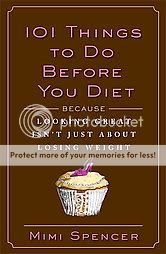
101 things to do before you Diet by Mimi Spencer.


The full title of this book is 101 things to do before you diet because looking great isn’t just about losing weight.

I picked up this book expecting a list of things that would deemphasize weight loss. You know what I mean. The title says that looking great isn’t about losing weight. So naturally, I thought the book would not be about losing weight and about loving the skin you are in. I was wrong. The book was absolutely about losing weight in everyway. It wasn’t about feeling good in your own skin, it was about the path of least resistance towards looking, feeling, and eventually being thinner.

Quite a few of the 101 things were just style tips to distract you from hating yourself. They were also awfully specific. Tips like blow dry your hair, wear heels, and wear opaque black panty hose were on the list. These are not tips that people need when they are told to find their own style and love the unique and wonderful person they are. These are the tips that are told when someone thinks that there is a uniform right and wrong for everyone. The right, of course, being skinny, and the wrong, of course, being happy for the person you are without changing a single thing.

The whole chapter two was about how to eat. I skipped a lot of this section. The author talked blood sugar, hormone levels, the importance of breakfast, and eating healthy food. For a self proclaimed not-diet book, this section was all about how to change eating habits to specifically lose weight. There was nothing about eating great to feel great, it was about eating great to lose weight. This chapter made this book a diet book. The only reason they couldn’t call this a diet book proper was because this chapter was extremely ill informed. She off handedly mentioned that one could try the raw food diet as a tip. You would need supplements, maybe, the author doesn’t know.  After reading that, I felt like I could take these tips with a grain of salt.

There was another chapter on exercise. I felt like I had to skim this section as well. She didn’t talk about exercise for fun, happiness, and new life experiences. She broke exercise down into calories. Truthfully, people that think about exercise in a healthy way do not do that. Sad joggers think about calories, not happy ones. This chapter also made me think that this not-diet book was actually quite thinly veiled.

The author is very obviously a magazine contributor. She obsesses about weight, beauty, and glamour in her own life and these insecurities are evident on every page of this book. She skims across useless tips and over the surface of deep topics at the same depth as, well, a magazine would. I’d say to get equally good content, you should pick up an issue of Cosmopoltion or Redbook. At least there would be pictures.

What I did for Love by Susan Elizabeth Phillips


I was looking for something specific  while browsing through my local library romance rack. I wanted something with a wedding about young star crossed millionaires. I didn’t want the book to be about Christmas, and I didn’t want it to be about cowboys. I wanted something about celebrity and glamour. This book fit the bill.

The book is about a former sitcom actress and recent divorcee Georgie York. She is tore up about how her handsome actor husband, Lance, left her for a more glamorous actress. Bram Shepard costarred with Georgie back in the good ‘ol days but has since been ruined professionally by his own debaucherous nature. Georgie has lingering resentment about how his bad behavior led to the canceling of their show. He also callously played with her emotions in an unforgivable deflowering episode in their youth. One deus ex machine later they find themselves married the morning after a possibly drugging incident in Las Vegas. They decide to stay married because of paparazzi hounding and bad press. They decided one year of marriage would not look suspicious, and Georgie offered to pay Bram for his involvement. Hate and repulsion turn into respect, respect turns into lust, lust leads to sex, and after a second deus ex machine involving a SARS quarantine with ex-husband Lance and new wife, sex, professional development, and standing up to ones ex husband turned into love.

The description of Georgie matched a young Julia Roberts but the incident with her ex husband sounded overly similar to the Jennifer Aniston, Brad Pitt, and Angelina Jolie love triangle. The description of Bram matched Chase from Gossip Girl. The character descriptions relating to famous people felt a bit thin actually.

 I really enjoyed the book. The character description was sufficiently glamorous, and I ate up every word. It wasn’t as glamorous as Adored by Tilly Bagshawe, but the wealth and celebrity were juicy.

The writing was very good. The book flowed with character consistency and descriptive scenes. This wasn’t like the awkward scenes and hand motions evidenced in The Princess Bride. Sure, I had a feeling that the author might have watched the Great Gatsby before writing the quarantine scene, but there is nothing wrong with having modern influences. It was sort of topical, like these characters live in a world much similar to my own.

My only qualm about the writing is that it seemed like the only thing that moved the plot forward were these little improbable setups. It is much easier to make characters confront their problems when they are forced to be in a room together for whatever reason. Sure, this story could not present the conflicted feelings about falling in love with someone you are already married to like Georgie and Bram finding themselves married after a morning after.  I forgave the first time. The second plot device with the quarantine was paper thin.

The sex was descriptive, copious, and non-repetitive. Repetition is a problem these romance novels seem to have. People can only draw on their own experiences for things like this, so it makes sense that people fixate on different part of the experience. Like, in the princess bride, it was so breast centric that every instance of sex was almost the same. That was not a problem here. Sure, there was a lot of opening-her-thighs, but on the most part, it didn’t seem like a copy paste of the previous incident.

There were three weddings in this book. The first occurred off stage ala Britney in Vegas. The second occurred for the press in a Great Gatsby inspired 1920’s cathedral. The third in the final pages was the only “real” marriage with just a friend and a few family members. The third was probably the wedding ceremony implied by the cover. I am glad they included that because after reading the part about the vegas wedding, I felt like I was being deceived by the cover ala The Princess Bride.

Near the middle of the book when the characters start to have sex and regularly share their marriage bed, I realized that they should just stay married. But the characters really wanted to split up, and I had no idea why they would do that. They were in a monogamous relationship where they help eachother with their careers! It couldn’t really get better than that. I suppose that is why people write fiction about these sorts of things, so you can get personally invested in a strange situation. That is also probably a credit to the author, to manipulate my feelings this way.

Overall, I recommend this book if you want to take a break from serious literature and indulge in a delightful confection of a book.

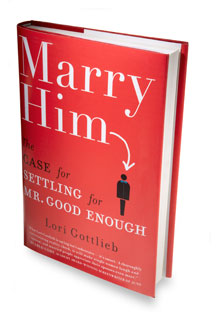
Marry him: The case for Settling for Mr. Good Enough by Lori Gottlieb

This nonfiction is about sucking up your pride and lowering your standards about men or you will end up alone, sad, and regretful like the author. Lori Gottlieb offers herself up like she is the biggest nightmare you could imagine. She is the 41 year old single mother  (who in every other respect, has it all). The book picks apart her dating life with the kind of concise pessimistic eye that could only be had in hindsight. She begs the reader not to make her mistakes. She goes in through detail about what those mistakes are, how easy it is to make those mistakes, and how many of her friends have already made them.

I found the content repetitive and the book too long. I think I might have sufficed with the original Atlantic Article that this book sprung from.

It probably didn’t help that I have heard all of this before from my mom. All throughout my life she has said things like, “ [imagine a filipino accent] If you do not find someone to marry, you will be all alone”. And, my mom trying to tell me to act before my ship has sailed, “You better watch out because if you wait too long, the ship will leave you and you will be all alone”. The book went on and on and on. I relived the 20 years my mom preached that any man that does not hit you is worth marrying. The book felt that long. It also didn’t help that a lot of the story was about her friends as well. It felt gossipy, and at the very least, not very scientifically rigorous.

My biggest criticism for the book is that she never really defines her audience. She assumes every woman has the resources to live and work alone and raise a child alone. While she says that she is struggling financially, the fact that she is able to do it at all indicates that she has done well for herself.  Not every woman risks being overeducated, and at the risk for never settling for a man because they forgot they needed one. Gottlieb doesn’t realize it, but she is only speaking to a very well off class of women. She is speaking to the class of women that have the capability of making a choice. In fact the other side of the coin is far more scary. There are lots and lots of women out there that are in physically and emotionally abusive relationships that don’t have the social and economic resources to get out of them. Some women aren’t educated enough to know that they deserve better. She isn’t talking to them, she is talking to well off women like herself.

But it is implied. She tells us to throw a few more dates to the shorter and sweeter men of the world instead of spending that type looking for unicorns. I just wished that she offset some of the time she was telling us that we are far more unattractive than we think we are to explain that there are some universal dealbreakers that we shouldn’t settle for.

She didn’t say however, that you shouldn’t wait for someone you love. She just says that love might be different than you think it is. She likens (what she thinks is) western love to the practice of arranged marriages. Love is something that grows when two people have committed to eachother. That is something she learned from her Indian friend.


I don’t regret that I read this book. I found it convincing, and frankly, just because of the part of my life I am in, the message was something I needed to hear. I just know I should take it with a grain of salt. The author has legitimate regrets that she overassumes that we will have. I am a pragmatic person and I have never had the fairy tale fantasies that she assumes every woman has. As a matter of fact, I think the life she lives doesn’t sound so bad at all. She is a glamorous well educated female author with a son living in the big city. The whole basis of her book is based on a fear, and maybe, just maybe, its not really something to be all that afraid of. 

The Princess Bride By Diane Palmer


This book is misleading. When I picked up this book, I made two assumptions. The first was the unlikely chance that this was the book version of the popular movie staring Indigo Montoya.  This is the assumption that all the Barnes and Nobles reviewers had, giving this book a lofty 4 stars. The second assumption was that the book was about a princess. That is also incorrect. 

I also felt mislead by the first sentence

“Tiffany saw him in the distance, riding the big black stallion that already killed one man”

The book was also notably not about the horse, who was never mentioned again.  The book cover was misleading in a less nefarious way. The main character has long black hair, not short, and wore a prim white suit to her wedding, not a dress.

The book WAS, however, about a virgin whose husband married her just to get into her pants.  The ex girlfriend gets in the way a bit.  The male lead was named King, which might explain the title of this book.

Before we really get started picking this book apart, let me say that I can not recommend this book. The story lacks in every way.  It fails in  the juicy romance novel criteria with its lack of juicy sex, romantic love, dream weddings, and unattainable glamour. It also fails in the more expected traditional metrics with its lack of character development, scene description, and story arc.

Most of the drama comes after the sex. After he gets what he wants, they find that they don’t know eachother and feel uncomfortable talking to one another. It is the worst marriage I’ve ever read about. By the time I get to the final stretch in the last few pages, I realize how ridiculously addicted to drama these two characters are, with all their problems stemming from their strange decisions.

The sex itself was vague and unsatisfying. There was only one instance of penetrative sex in the whole book, and it was the awkward breaking of ones virginity. This single instance of sex led to pregnancy. All of the sexual tension brought on in the book had a lot to do with breast manipulation, which I found stiff, and just plain not sexy.

There was a wedding involved, but it didn’t take on the satisfying characteristics that you normally get out of romance novels. It was like a lame wedding I could put together last minute, not the fantasy feeding dream that  we read about to have in our lives when we can never attain them.

The most glamorous part of the book was their trip to Jamaica. They were rich enough to afford two impromptu return tickets home after one day. That is definitely a luxury I could not afford. When I go on vacation, I have to stick to my itinerary. I am that poor.

The lack of character development was disappointing, but not distracting. I could have known more about tiffany’s motivations, and what part of her selfish pathos might have to do with her dead mother. They mentioned something about King’s past in the beginning, something about how his mother brutally took advantage of or killed his father to explain why he wanted to remain a lifelong bachelor. Unfortunately, this potentially interesting character tidbit was not addressed again when he decided that he actually did want to get married. If I met a person like that in real life, I would be completely put off by how much introspection said person lacks. Sure, the book isn’t about King and his pathos, but helping explain his worldview is what makes me care about what happens to him.

The story arc disappointed me because they decided to bring up huge drama in the last 3 pages. Maybe it wasn’t that huge to the author, but rather just a last string to tie up, but it felt like they dropped a bomb and decided not to explore it. The book ended abruptly after a major life decision was made, and it got all tied up in a neat little bow.

I usually feel like reading is the act of getting to know someone you never met. While I can’t assume that the author bared her soul with this work, I can say that I feel like I met her. She told me a story. I explored the depths of her mind and found not much to speak of. Maybe that is too harsh. Maybe she just didn’t do a very good job.

The Marriage Plot by Jeffery Eugenides


I picked up the marriage plot because I greatly enjoyed Middlesex and heard that The Marriage Plot was a little lighter, perfect for a relaxing spa day.

The three main characters are senior Liberal Arts undergraduate students at Brown University.  Madeleine is a notably beautiful literature major hoping to publish her Victorian writing analysis. Her main beau, Leonard, started as a tall handsome smarter-than-thou philosophy student then spiraled tragically into poorly medicated manic depression.  The completion of the love triangle is Mitchell, who does his job poorly and mostly pines from afar. Very far. He pines from Paris, London, and then from Calcutta.

I feel like the love triangle line wasn’t as love-triangley as the book flap makes it out to be. Sure, there is a third person in the love story, but Mitchell doesn’t make much of an impact on Madeleine’s decision making, and she never really reciprocates his love at all. The thing that comes closest to making this trio a love triangle is one awkwardly poignant description of Leonard’s single sexual fantasy of Mitchell and Madeleine together. I hope that didn’t sound weird, that accepting inclusion of the most banal and disgusting aspect of our lives is what makes Jeffery Eugenides an excellent author.

The heft of the book comes from long sprawling dialogues that give me an idea what it must be like to be an introspective liberal arts student in college. They talk about things like Nietzsche and finding yourself. These are things I could not personally identify with. They spoke about philosophy like you weren’t anyone until you had an existential crisis. It was fun to play along, to be apart of that conversation. It made the characters people I didn’t know, instead of cardboard cutouts representing myself.

(spoilers)
The book takes a turn after Leonard and Madeleine get married. It was a wedding in a book that was completely unsatisfying. It happened without any description what so ever. The scenes that took place on the honeymoon were downright strange. These scenes were not charming, although they very well could have been. Sure, Leonard was getting more and more insane as time went on. I felt like the most manic he sounded was during the taffy shop incident, and didn’t have to be pronounced during the count Dracula casino incident.
(end spoilers)

Of the three protagonists, Madeleine was the least fleshed out. At one point she was described as an upper west side looking woman, and that felt like a surprise. At that point, I had no idea what she looked like. People would describe her as sexy, pretty, and composed, but nothing more was ever said. She is also described as very upper middle class. Her father is described as the president of a very small college, and inexplicably pays for everything. Madeleine seems to get everything she ever wants without so much as a thank you.  She doesn’t act like she deserves it, recognizes her priveledge, or even acknowledges its there. She just is, and things just come to her. Perhaps Madeleine is simply not decisive, aware,  and confused about her future, but I don’t think so. I think this the weakest part of the book. Madeleine was poorly drawn. In retrospect, The Virgin Suicides was about young men observing the strange habits of young women. Perhaps, Eugenides shouldn’t be remembered as the man that draws interesting young female characters, but rather, has always tried his best to observe them.

While Madeleine was poorly drawn, Leonard and Mitchell were very interesting. I loved hearing about Mitchell finding his religion. I thought he responded to situations in interesting and insightful ways. The scene in Calcutta with the agronomist was especially memorable. His embarrassing moment in Greece when he tried to speak in tongues was also interesting. It was one of those moments that happens to everyone, but are rarely shared. He took a leap of faith, and it didn’t pan out.

My favorite moment with Leonard was the moment he kissed the taffy girl. It was so bizarre, yet, you didn’t realize he was crazy until that moment. That moment shed new light on all his activities that day. Those moments are amazing. Its like how at the end of The Descent when you realize that she killed her friends.  

The thing that put me off the most about this book was the upper middle class white privilege every character except Leonard possessed. I read a review before I started reading that said that this book was Eugenides attempt at capturing the essence what it meant to be a young American. When I found out that he meant rich white kids in college, I was heavily put off. The characters were making choices they had the luxury to make. They could think of things like religion, love, and health because they didn’t have to think about money and self sufficiency. Is that how everyone else grew up? Because I didn’t. It’s a nitpicky thing, and it doesn’t put me off from the overall experience.

I highly recommend this book. It was a good read, and I enjoyed every page.

Princess in Love by Julianne MacLean


I picked up “princess in love” at the local library because it was in the romance section and it had a princess on the cover. I’ve been reading Game of Thrones for a whole year and I just needed a quickie to get it out of my system.

I don’t think I need to defend romance novels here. Romance novels are the workhorse of the publishing industry. Romance novels are, from a pure numbers standpoint, porn for women. Every trade-in bookstore eventually devolves into a used romance novel store, and I think those business owners are fine with that.

There are good romance novels out there. This is not one of them. Sure there is a busty princess on the cover, but that is as steamy as this gets.

I normally describe the plot somewhere in the first three paragraphs. I can’t really say there is a plot. I mean, stuff happens, but I think it takes more than that to make a plot. Rose and Leopold have some kind of previous romance. Maybe that was described in the previous book? Well, anyway, Leopold can’t let it go and decides to keep on messing with Rose’s head even though she has a chance at a happy healthy relationship with the future king of Austria. When Rose realizes how manipulative Leopold is, she goes ahead and marries the Austrian. When the Austrian dies, Rose runs back to Leopold because she wasn’t doing anything else I guess.

There is only one instance of sex in the whole book. Everyone had all of their clothes on.

I am going to have a hard time giving this book a fair shake because I did not enjoy it. Sure it was easy to read and I finished the book, but that doesn’t mean that I don’t feel like I wasted my time.

The characterizations are poor. Leopold goes from a spoiled heir indifferent about his father’s political beliefs into a raging emotional maniac. He ignores everyone around him until the crucial moment when he gets in everyone’s business. I don’t know what to expect from him. He is not one person with a rational train of thought and motivations. That is more than I can say about Rose, though. Rose doesn’t have a personality at all, not even an inconsistent one. Stuff just happens to her.

The best character was Leopold’s Mother. She had about two lines and Leopold thought of her three times. Each of these vignettes mentioned that she liked flowers. That’s one thing I can hang my hat on for crying out loud.

Don’t expect any descriptions of scenery, clothing, pomp, or circumstance. I mean, its not like it’s a historical fiction about a royalty or anything.

The last thing that bothered me about this novel was the pacing. It runs uncomfortably hot and stiff for 2/3rds of the book. When something mildly interesting happens to the Austrian prince, the book wraps up like a cafeteria burrito.  Its like the author hit her page limit or something.  Seriously.  The Austrian prince drama occurs, then, fast forward 10 years to when Rose as a child and a dead husband and she is ready to see Leopold again. That’s the last chapter of the book.

Don’t read this book. It won’t deliver.

Honeymoon by James Patterson

I have no idea why this novel is called Honeymoon. There wasn't even a honeymoon in the story. I guess after you become the most prolific author in the world, titles don't mean so much.

The story is about the stunningly beautiful brunette Nora who happens to kill the men in her life for money. She raises a few red flags when she transfers a huge sum of money from her most recently dead beaus account into her own, and an investigation begins. An insurance agent named John O'Hara poses as an insurance salesman who steps into her life and makes the near fatal mistake of sleeping with her. They go through a small period of cat and mouse and eventually justice is served.

There is a B story about a briefcase and some offshore accounts. It was supposed to tie the story together and I think may have tried to make some sweeping commentary on american politics, but it was too little too late. You couldn't add weight to this book even if you put an anvil on it.

This book is complicated, recommendation-wise. Although I can't say that I recommend this book, I could definitely use this opportunity to recommend James Patterson novels in general, especially this one (know what I mean?). It is an extremely fast addicting read. I can't say I'm better for it. The chapters are short, the women are beautiful. The plot is sparse, as if it just a backdrop for the antics of the glossy magazine characters. Its complicated, but you can't say the same about the story

You've Been Warned by James Patterson and Howard Roughan

This book has two stars on amazon. I didn't think it was so bad. I mean, it isn't something I would read again but it was quick and served its purpose as a one-chapter-before-bed novel. Well, it wasn't so great at that because I have to admit that I had a nightmare over it once. Just once though. 

This book is a first person point of view about a young nanny/photographer in New York City. (It seems everyone is a something-slash-something in New York City, but thats neither here nor there). She starts having peculiar things happen to her which makes the audience thinks she is crazy, but she accepts them in a dreamlike way. The peculiar things are very crazyperson-like like hearing music in her head or seeing cockroaches on her skin but it turns out she is in hell. You would think hell is slightly scarier than a bad trip, but no, it turns out that the big reveal is that she is in full-on serious hell. I know. I KNOW.

The second kick in the pants is why she is in hell. It turns out that she is in hell for sleeping with a married man, not taking part in the murders that lie central to the story. At the end of the story you get the same feeling you got when it turned out that the book your parents gave you in middle school had a lesson.

About half way through I felt as though the story was just a nice exposition on what it might feel like to be a crazy person. In that way the book excelled. I understood some of her actions as strange as they might have looked from a street observer.

It probably got two stars because it felt like a particularly bad Sunday school lesson by the final chapter. Be even the most innocent of mistresses and you'll end up in hell. Even if you are in love, even if your a photographer. You will end up in the helliest hell you've ever helled. Its like when you are watching a cooking documentary and it turned out it was sponsored by PETA. It turned out that the moral of this book was Jesus.

Well played James Patterson.

Chicken Soup for the Soul: Runners

I'm glad I read Born to Run already, because if this was the first running book I'd read I would quit altogether. Maybe I'd quit running too. This book wasn't inspirational. I know that people can write more inspirational stories about running, every issue of Runner's World Magazine has something honestly inspirational in it.


Going into this you know that its going to be hit or miss. There are 31 stories, 31 individual contributors, and at least one of them is going to just downright suck. It just wish there was at least one great one.

Some of the short stories were memorable. One was about this guy that started running because he started seeing an obese neighbor running past his house twice every single day. He starts running because he is fat-shamed into thinking he is less fit than an obese person. After his marathon, he talks to her and finds that she had just been running to Mcdonalds to read the paper every morning. That one made me laugh out loud. Then there was this other one about a girl that proclaims that she used to be fat and unhappy. Now that she runs every single day and spends hours at the gym and never eats, she, at 18 years old, is the happiest she has ever been. I laughed out loud at that one too.

It just didn't feel like they dug very deep. Sure runners are supposed to be healthier, thinner, happier, more beautiful people that statistically will make more money in thier lives, but geez, it seemed like the only thing they ever talked about was how thin and happy they were.

Over-the-top Ultramarathoner Dean Karnazes' story was billed to be the biggest draw. He is on the cover and the same photo is used inbetween sections. That's a dozen instances of Dean Karnazes. His story wasn't particularly moving is the thing. His story was about how his daughter wanted to do a street race with him and showed a particular amount of courage by pushing through the pain. His contribution wasn't about him, it was about his daughter. I understand how that could be one of the most memorable moments of his life, but it just wasn't particularly moving since the whole world doesn't idolize his daughter. We wanted to read about Dean Karnazes for goodness sake. I wanted to know why he ran that first time, why he ever ran a single mile over a marathon, and why he chose this to be his whole life, his lasting contribution. Certainly it wasn't so once he was known the world over for running, he can see his daughter show a precocious amount of grit on race day. Sure its nice to have a story by Dean Karnazes in this book, but I don't know if his contribution was worth a cover.

Then there were the cancer survivor stories. Cancer survivor stories are intrinsically motivational. No one can fathom just how painful that brush with mortality is until it actually happens. Too bad that the tales of cancer survival played out like lifetime original movies. Most of the stories were also written by friends of cancer survivors, which had almost no depth at all. It makes me wonder if there was a stack of cancer survivor stories that they rejected because they were too real.

The triathlon stories were neither here nor there. And they were all the same. There I said it.

Would I recommend this book? Hell no. Take your $11.99 and go buy Born to Run.

The Postcard Killers by James Patterson and Liza Marklund

I picked this book at a mom and pop trade-in paperback store. These types of stores are endlessly fascinating for me and even though I wasn't itching for a read, I picked this one up for 4 dollars.

The story centers on four characters: two killers, a brash NYPD detective abroad, and an unwillingly involved hot-to-trot journalist. The story takes place mostly in Sweden, despite the novel having an Eiffel tower on the cover.  The killers were a couple of sexually charged young adults named Syliva and Mac who bewitch other young couples into date shenanigans abroad only to leave their throats cut and bodies gruesomely posed. The killers then send a postcard to a local newspaper for press.

The NYPD detective has a hat in the ring because his own daughter was one of the victims. He flounces around all emotionally charged and making brash stupid decisions. I can tell by the end of the book that we are supposed to see him as a Captain Kirk figure, the type where they get their strength from their humanness, but I just saw him as an incredibly unethical police officer working WAY WAY out of his jurisdiction. The characterization felt forced because his personality was not consistent. The book decided that he was emotionally unattached and terrible with intimacy about 3/4ths the way through the book. He sounded incredibly emotionally open before this point.

The lady journalist, whats her name? Dessie? I think the Swedish Bestselling co-author got a chance to shine with this one, but it was really too bad that Dessie was incredibly boring. Dessie spent the whole book regretting stuff and worrying. She did nothing to drive the plot forward. She was the ambassador to Sweden, translating for the Detective, connecting him to all the right people, and eventually having sex with him when he needed to crash for the night. But I got to learn some neat little Swedish tidbits through Dessie, like about local texture of the Swedish Countryside and the international fanfare caused by the Arctic circle Ikea. (as a sidenote, it complete cracked me up that the Ikea was a central part of this book about Sweden. Its like if we went to France and everyone is eating french fries and wearing berets.)

The fun part of the novel was trying to figure out what the motive of the murders were. The book shined when we got into Syliva and Mac's back story.  The tension pacing of the book was a little thrown off because of it, but I think I understand what they were going for. You see, when they released Syliva and Mac from police interrogation because they were ruled out of the case, the story was really picking up and it was terrifying that the real killers were being set free. Then the detective drops everything and flies back home to relax with his buddies in the United States. He had to do it because Syliva and Mac were from the LA area and he needed some hometown investigation. It felt like he ducked out of harms way and took a vacation. Sure, the book still remained interesting because we learned the entire UCLA backstory at that point, but still, the pacing was chaotic. 
A key point in the novel is when the newspaper company tries to draw the killers out by offering money for an interview. The key was to entrap them into revealing thier identies so they can be arrested. Syliva and Mac do not take them up on that offer. Then they somehow make a "mistake" in their crime pattern which leads to their identities being revealed. In the book it is implied that the paper caused the break up in crime pattern, but I don't get it. Sounds like they didn't take the bait to me.

So I understand the reviews for this book were bad. I didn't think it was that terrible. It was quite entertaining I thought. All I expected was a frothy read to pass my time in incredibly short bursts. I packed this baby in my massive purse and got it read in 3 days. Perhaps all the reviewers did not like how the killers were revealed right off the bat?

Into the Wild by Jon Krakauer


I just read Into the Wild by Jon Krakauer. The book chronicles the now infamous Chris McCandless, the young man that died during a romantic extended camping trip in the Alaskan wilderness in 1992.  His life has been much considered as there have been numerous essays about his life and motivations.

Here is the plot, briefly. Chris graduates Emory college with honors and defies his parents by not continuing onto Law School.  He instead decides to travel across the United States, taking on the moniker Alex Supertramp. His transition to independence from society is a slow one, as he spends a few years taking on odd jobs under the radar and finding shelter when it comes. His ideals (and ego) are fueled by the fictional loners penned by Jack London and Henry David Thoreau. He eventually hitchhikes up to Alaska to live off the wilderness with embarrassing low provisions. He dies after an impressive 112 days.

The book is written so carefully, so respectfully. The author frequently mentions other writers and outdoorsman who bash McCandless’s inexperience and arrogance who imply that such a lack of respect for nature deserves death. Krakauer goes completely the other way asking us to remember what it was like to be young and idealistic, when we were ready to die for our beliefs. Well, this young man did.

Chris dislikes his parents. The reasoning is abstract and I’m sure the actual relationship is more complicated than the book could even describe. What is for sure is that Chris didn’t have a solid reason to not like his parents. He grew up privileged with loving parents who gave him everything he ever needed and encouraged positive behaviors and life paths. It would be nice if there were a cut and dry reason for Chris to set out on his own, but there wasn’t. If it were me and I had the inkling to do a life adventure like that, I just wouldn’t be able to take myself seriously. That is definitely something Chris could do, and that was take himself seriously.

It is sad that he died. What makes it worse is that he was ready to go back into society with renewed vigor when he realized that he couldn’t. He planned out this romantic trip because he had a problem with his world view that made relationships unbearable. He planned a trip so he could get away from it all for while. And it worked. That’s the crazy part. It worked.  He felt more grateful for the things he had, he missed his family, and he was ready to enjoy being a productive member of society.

My only qualm with the book is that the author spends a little too much time talking about other explorers that met the same fate. He takes it too far  when the author includes his own climbing adventure to the list of other great blunders. That unnecessary portion made the exactly 200 page book a little irksome, like he was rushing to meet his page quota.  It doesn’t help that the few lines of text that the author managed to scrape up from McCandless’s post cards and diaries are repeated multiple times in the book, sometimes to exhaustion. I realize this was necessary to ground the timeline in a circular plot, but after reading the same post card for the 4th time, it felt like just poor writing.

I definitely recommend this book. In a world where life is so cut and dry, where actions and consequences rule our every decision and foresight trumps every plan, it is amazing to read about someone who rejects the worldview of the ever shrinking room. Sure he dies. I bet that gives us the affirmation we need to stay trapped in our comfort zone. 

Summer Haitus

Dear Loyal Readers,

Like the school children and teachers that have laid the foundation of book reviews, voracious reviews will take a summer haitus.

Happy summer reading!

Sincerely,

MZ

Pattern Recognition by William Gibson


Pattern Recognition touches on a number of hot button issues with me, as if it were designed to appeal to my interests:  Internet memes, international travel, solving puzzles, etc.  The main character is a marketing consultant, starting the book traveling to London to evaluate an advertising campaign for a client.  She is also active in an online community that's obsessed with a series of video clips that have appeared online, without any attribution.

Early in the book, her employer takes an interest in these same videos, giving her a chance to explore her personal obsession with the financial backing of a very rich man.  Her journey takes her to three continents, and she meets numerous colorful characters.

I enjoy how the characters throw themselves into their obsessions.  Their obsessions are what define them, and how they define themselves.  The allegiance that the main character feels for her particular corner of the internet is familiar to me.  Most of the characters embody the sort of tribal social order that seems more and more common, with people banding together around a shared interest rather than simply shared location or employment.

The book is well written and the mystery is interesting, but I was surprised to realize that there were sequels.  The mystery of the footage is neatly wrapped up at the end, and I didn't quite make the kind of connection with any of the characters to be interested in what they're doing next week.  I'll read them anyway, eventually, but I'm wary of being Ringworlded, where the sequels take the wind out of the sails of a an excellent first book.

Before I go to Sleep by S.J. Watson

'
S.J Watson writes analytically, tying up loose ends and answering questions about suspicious plot holes before we can even sniff them out. This is both a good thing and a bad thing. A ludicrous plot line does not cause a lack of trust in the authors skill. On the other hand, the perfectly tied up story lines and too-sensible actions of the character make me feel trapped. She writes as if it is the real world, with gravity heavy enough to support a real life. My life is already like that, and I can not enjoy fiction that does not take risks.

Before I Go To Sleep is about a woman, Christine, that has a rather unusual form of amnesia. She can retain memories for a single day only to lose everything when she goes to sleep at night. The plot moves forward by use of a journal that she writes in and reads from start to finish every day. The book tells the story from the journal's point of view. She finds some things out about her past through selective memory recall, namely that she may not be able to trust her caretakers. Here is where I would normally give you the spoilers, but I have grown as a person and I will acknowledge that only a single tension compelled me to continue reading until the end. It sincerely took me by surprise. I only started sniffing out the twist 30 or 40 pages before it was revealed.

The landscape of the book wasn't very intriguing. It took me days of reflection to realize it. The same things happened everyday, and they weren't that interesting. I could have spent my time looking straight at the walls of my blank bedroom instead and have gotten the same amount of detail about her house and life. Watson spends lots of time reintroducing that house too. I'll give her the benefit of the doubt though, she might have been using that repetition as a illustrative device to demonstrate the tedium of the situation.

The lack of autonomy bothered me. I mean, I know she has amnesia, but she is still responsible for her actions. She has to be reintroduced to her life every single day, and yet she chooses to allow the same thing to happen the next day. She doesn't give up the security that her husband and suburban life give her and allows herself to sit helplessly at the feet of the system. I do not think she is helpless at all, but she acts it. I don't think I can pin this on poor writing. It gives Christine a personality that is completely separate from her memories. Christine is that lady that went to grad school because she couldn't find a job and got married when she wanted to start having children. She thought about it too much, and it led to a boring and too-safe life. I drove me nuts. She could have taken the bus out of there at the drop of a hat, but she was too afraid of what might happen. This is how extreme domestic abuse happens even when women aren't mentally handicapped.

Overall, read if you like amnesia stories.  This one isn't terrible, but its not great either.

The Lucky One by Nicholas Sparks

This is my first Nicholas Sparks novel, although I must admit that I cried like a baby while watching "The Notebook". (I also cried like a baby when I summarized The Notebook to my friend two days ago). I figured that I wanted to see what type of writing enchants the world population in the way that Sparks seems to do time and time again.

The book is about an ex-marine who walks across country to find a woman. This woman is special to him because she is in a lucky photograph he found in Iraq. The biggest conflict of the book is the woman's ex husband who unreasonably does not want her to date anyone else.

It was pretty enchanting. The ending was very powerful, jumping off of the page like a movie. The ending conflicted greatly with the robotic movements and flat dialog that plagued the rest of the book. It is as as if he wrote a rough draft of the book, then did a second draft of the last two chapters, then published it. 

I'm probably not the first to say that the conflict is flimsy. I will give Sparks some credit though, he certainly gives the exhausting and petty aspects of relationships the gravity that bored housewives probably want. I mean, I don't care about ex-husbands and I think Beth and Logan could have told Clayton to piss off from the beginning and live the rest of their lives in peace, but then again, I have never lived that life and I don't know how stressful that stuff can be.

I had one odd moment while reading this book. I thought "it is all a conspiracy". Sparks isn't a person, he is a program that distills field interviews from the target audience. In this case, it wrote a book that panders to single mothers who feel marginalized by their ex-husbands. What they want is to get love unconditionally without having to work for it. Preferably love will fit right into her life without her having to change anything, maybe he will work in the family business and not have any friends or family for her to deal with. Yup, Logan made a grand gesture of love before he even knew her. She doesn't have to feel good enough to deserve it, she just has to be the person in his photograph. It just seemed too perfect.

And he listened to her vent about her problems without judging her, interrupting her, or even trying to fix her. Sparks made a big point about that.


In Roger Ebert's review of the movie he writes
I've seen him in interviews where he's better-looking than some of his leading men and comes across as sincere. I think he really does believe in his stories, and I think readers sense that.
I bet Ebert got the pandering feeling that compelled him to write this. 

But it was enchanting nonetheless. Maybe robots will write all our books, and we'll be better for it.

Other Notes:
- I sensed this with the late Michael Crichton's work near the end of his career, namely Prey. Editors get insecure and don't push enough when the authors get too famous. The authors just assume that everyone will love the book and it will be turned into a movie. All this causes the books to sound like screenplays. Scenes get grander (with more water) and only actions are described. The author abandons  point of view all together.
-  One plot hole: When everyone is rushing to save the son, how did Clayton know that the tree house was dangerous? He wasn't involved in that at all. Him running out to help was also uncharacteristic. 
- I grew uncomfortable when everyone started calling Clayton simply "the ex". I doubt everyone in the entire town would call him that. It showed me that he didn't have voices ironed out. I just don't think Nana would call him that.
- the cliffhanger being resolved in the epilogue was cute, I liked that.
- This is the first review where I didn't spoil the ending. let me know if you want to know what happened.

-

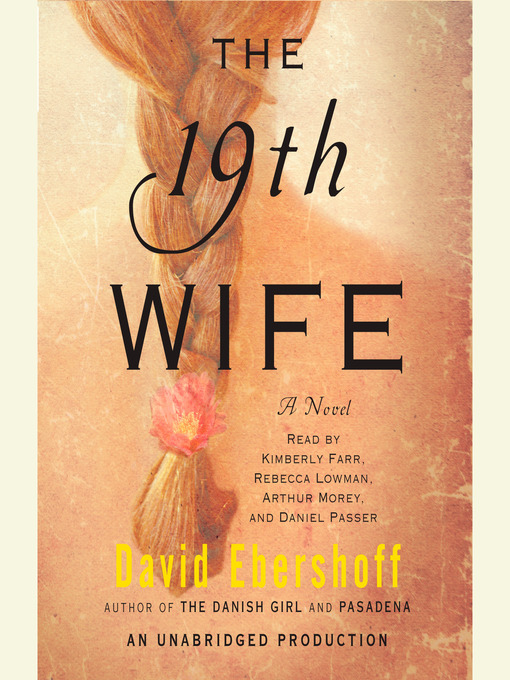
The 19th Wife by David Ebershoff

Many people describe The 19th Wife as a combination of two books: a murder mystery and a historical fiction. Saying that the author completes two whole different ideas is generous. He is just trying to get all the way around the idea of polygamy. I think a more accurate thing to say is that he uses many voices to paint a vast, vague, and inconclusive picture of polygamy.

The book follows two different timelines. The first is sort of a Ann Eliza Young fanfiction based on her confusingly similar titled autobiography. The second timeline is about a young gay man, Jordan, who solves a murder mystery to get his accused mother out of jail. His mother was coincidentally a 19th wife, and through Jordan's story we get to catch an outsiders glimpse of a fictional polygamous cult.


The author often cites the historical fiction segments as primary sources from closed Mormon church archives. Ann Eliza Young's real autobiography is called Wife #19. The author cites her work as The 19th Wife.   As you are reading the book, only a few things will tip you off that these aren't actual historical excerpts. For one, the author doesn't do a good job of shifting his voice. Even though Jordan speaks modern english complete with its slangs, idioms, and profanities, you can still hear the authors voice in the historical segments. Well, you have to look past all the highfalutin, proper, turn-of-the-century speak, but he is still there. The fake Wikipedia article is a smoking gun to how fake the rest of the book is.  But the only way you know for sure is because the citations aren't in MLA format.


That concealed phoniness was my only qualm about the historical fiction excerpts. They were at least interesting and had a powerful voice. Jordan's little murder mystery, on the other hand, was pretty lame. All the background characters had motive, and reasoning was so flimsy when they revealed the killer that they could have just picked the conclusion out of a hat. Not to mention that the mystery was at a complete standstill until the last 30 pages of the book. That is 500 pages of book where the murder mystery goes no where. It doesn't help that the main character keeps saying "I feel like we are so close!". You can't fool me, Ebershoff. 

The finesse-less editing was apparent when the book ended with a whisper. Ana Eliza's story had a big fat "The End" written at the end of her chapter. I turned the page and Jordon was still undergoing the second half of all the action in his story. There was an Epilouge that had a conclusion I cared more about than the true ending of the book. The author note explaining his sources and intentions should have been the blasted preface. That simple cut and paste alone would have removed all of the phoniness of the book.

I am sorry that I didn't enjoy the book. Normally New York Times Bestsellers are like crack, even if the book isn't very good. I actually had a hard time picking it up from time to time. It didn't even satisfy my voyeuristic fascination with polygamy because it wasn't sexy enough. The only explanation I have for the inexplicable sales without any of the goods is that they must have been going for the Mormon crowd. If that is the case, then the chaste gay relationship was a thinly veiled way to keep the mainstream crowd still gawking.

Other notes:
-A Los Angeles Times blurb on the back of the book states that "The 19th Wife is a big book, in every sense of the word". See, I thought that this meant that the book was full of texture, with enough content to  occupy my thoughts for days. Instead it turned out that a "big book" just means that there was a lot the book should have left out. It was just all over the place.
- Whats the deal with dogs? The author seemed so upset when his lifetime original movie excluded the dogs. I mean, it makes sense that he could be upset that they decided to rewrite Jordan as straight. 

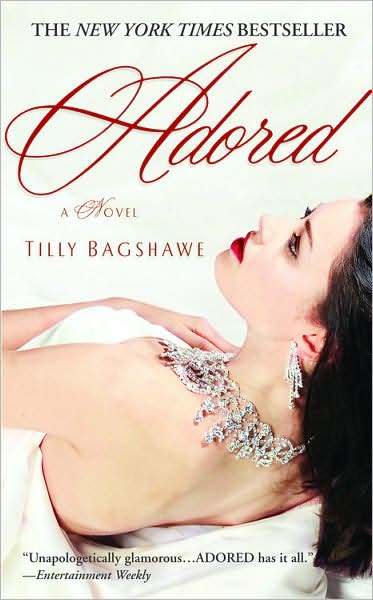
Adored by Tilly Bagshawe

I liked it. It is a self indulgent womens' glamorous fantasy. Who wouldn't want to feel like the most beautiful woman on earth with all the old money to be astute, all the new money to be lavish, and all the attitude to be in control? For 700 pages I experienced owning Armani suits, Louis Viutton luggage, and Hermes scarves. The plot and characterizations were at times subpar, but that didn't take away from the pleasure-of-the-flesh experiences the book so selflessly displayed.

 A short summary: Duke McMahon, the cowboy movie star and patriarch, survives the novel just long enough to demonstrate an especially glamorous form of cruelty to his wife, Minnie. He moves his mistress in much to the chagrin of his live-in adult children. Its a long book. A bunch of stuff happens and it turns out that the book is about Duke's granddaughter, Siena. She decides that she wants to be a model/actress even though her dad wants her to be a doctor. He disowns her and she flails around wildly and 300 pages go by. She eventually meets a wealthy producer that launches her career and challenges her libido. Spoiler: he beats her to a bloody pulp and it ruins her face and therefore her career, driving her back to her family. There is a poorly crafted love story in there and it ends with a wedding.

There is as lot to say if only because the sheer girth of this novel.

The Duke-Minnie relationship was gold and I wish we could have seen more of it before Duke died. I was endlessly enthralled about the thought process behind Minnie standing it. How on earth could a self respecting woman allow her husband's mistress to move in with them? That is the single defining quality differentiating a wife from a mistress. A wife takes care of house! A mistress takes care of the sex! I draw the line right there.
 
The Max-Siena relationship, not so much. Max-Siena is the poorly crafted love story that I spoke about earlier. You could tell that the Max-Siena was end game because he saved her life when they were little kids, but it wasn't believable when they were older. They just fell into eachothers arms out of convenience and began a relationship out of hate-born lust. All the sentimentality and tenderness that they reminisced about after the relationship just was never there. And Max crying endlessly afterwards? That just isn't believable.

There was an insufferable B-Story about Max's brother in England having financial troubles severe enough to "lose the farm", literally. The way it was tied up in a knot at the end, how it held an entire cast of supplementary characters, and how it only served as a place for Max to convalesce all qualified as fat that could have been cut right off the top. The book could have easily been 300 pages shorter and a lot less boring.

It is interesting how a book can be a Pulitzer Prize and not a New York Times best seller. Remember, I am reading this book directly after reading Swamplandia!, a critically acclaimed novel. Quality is such a loose word when judging books. This book isn't earth shattering, and I won't come away with it with an adjusted world view. (Although, maybe I need to buy a new purse). People buy what their friends buy, and then they go and buy what ever is on the New York Times bestsellers list. I just don't think that list is to be trusted to give good books.


Overall, read this book if you 
a) are female
b) feel like having a "light read"
c) Simultaneously want to exalt and execute the fabled 1%

Other notes: 
- Have you noticed how everyone is either tall and slender or 5'4?
- A 5'4 model? pft, maybe in SPAIN
- Is it just me, or is Max and Hunter two halves of the same person?
- Of course a book that exalts beauty to the extent that it does would have Poor Laurie die a spinster.
- Just because the second to half chapter is written in past tense doesn't mean that the book should be winding down.

Swamplandia! by Karen Russell

It is intriguing how the Pulitzer Prize in fiction was not awarded this year. I was incredibly intrigued. I followed the story on the Daily Beast and I read all the speculation on how this doesn't mean that the three contenders weren't good enough for the Pulitzer Prize. Well, if if one of them was good enough, why didn't one of them win? I think it was a publicity thing. No prize awarded is much much more interesting than a deserved prize being given. They've got to sell papers, right?


 Anyway, that's how I got suckered into reading Swamplandia! The first chapter made me immediately regret this decision and I held that disdain for three quarters of the book. It was just so damn depressing.

After the feeling of deep depression wears into a slightly bothersome but waning sadness, you realize that those feelings of unease as a child may have been founded and shared  by many forming the new american experience. Swamplandia! captures the quark and texture of offbeat americana. It was refreshing (to some extent) to relive my childhood in this way.

Swamplandia! is about Ava Bigtree, a 13 year old girl following her moms footsteps on becoming a side show act in thier sub par alligator theme park. When her mother dies, the family is torn to pieces. Without the star of the show, the theme park falls in financial ruin. Her brother, Kiwi, runs away to work on a lame rival theme park to raise money to send home. Her older sister, Osceola, dives deeper into a fantasy world where she is dating a ghost. (Here are the spoilers). Her sister casts herself away on a boat to marry one of her ghost friends like a lunatic, and Ava can't stand to be abandoned. She enlists a creepy bird contractor that she affectionately calls "Bird Man" to help her find her sister. He rapes Ava. (end spoilers) Then everything turns out okay.

Ava  is weaves in and out of innocence. Those drastic demarcations of naivity is what make this book a gem. It is hard to quantify what maturity is, what makes one act like adult. When you read those small shifts in Ava's mindset, the cross over hit you like a brick wall. She is at one point trying to save the park, then she is trying to save her sister, then she is just trying to save herself by just a small drink of water. She makes mental trade offs between drinking water and realigning with her rapist. She thinks about whether or not she believes in ghosts, and if it even matters what she thinks. I suppose that is what makes a book a "coming of age" story.

I have a theory about the red alligator. The red alligator was Ava's scheme to save the park. She found it while she was harvesting hatchlings, and kept it as a pet. For some odd reason that she can't even explain to herself, she took it with her when she went with the Bird Man to rescue Osceola. After the raping, Ava decides to run and deflects Bird Man's attention by throwing the red alligator hatchling at him. I think the red alligator represented naive hope.

It is clear how childish Ava is being when you see the hard reality at the end of the book. Osceola was sick, and they gave her drugs for it. They could never save the park, and it wasn't the end of the world.

I can see why this book was nominated for a Pulitzer. The writing is hypnotically textured like a Tom Robbins novel without the randomness, with a weighty nostalgia ala Steinbeck. It just wasn't a page turner. I didn't have the urge to come home every day and open this book like I did with The Hunger Games or even like 50 Shades of Grey.  There is some unquantifiable quality that makes a book a best seller and its not the same quality that makes it a fine piece of fiction.


Cannery Row by John Steinbeck

Its hard to say what this book is about. Laconically, group of adults throw two parties for their friend, Doc. Doc shows up to one of the parties.

The reason most people don't talk about what the book is about is because it doesn't matter what the book is about. It is not supposed to make you think. The whole book is a sensory experience. It was grand and irresponsible and tragic and it made my entire life feel fake. That is a massive feat. This piece of fiction made my real life seem fake. 

While I was sitting around thinking very seriously about whether or not I should peruse a masters degree, the people in this book were actually living. I did my nails and pondered taking a nap while the people in this book made mistakes and  had regrets and never forget this moment until they died. My life is nothing in comparison, or perhaps it is. Perhaps even the smallest things make my life real. I don't know.

What a piece of art. I feel as though my ability to review this is limited by my failure to be an expert in literature. (Disclaimer: I'm not a literary expert). Cannery Row was a fishing community with people from all walks of life. While some people sat by the bar wondering what sort of hijinks his friends are getting him into, a child fails to understand grief over this father's suicide. And its not such a big deal.  The moments of extreme happiness were punctuated by overtly simple tragedy.

All the characters had their moments. Even though Doc tolerated everyone so much, he still punched Mack when he was angry. Mack wasn't responsible enough to see through his actions, but he knew when he deserved a punch in the face. Eddie tap danced in the office alone because he was so excited about the party. The dog got tired of peeing on the floor and house broke himself. It was those little moments that built up a life.

I can't make any grand statements about recommending this book. All people could either read it or not read it. You would come away with something, though. People that read these stories share a collective history and reminisce in the same way. Reading Steinbeck is like remembering that you are apart of a family and a community where every person matters.

Other Notes
Everyone who found out I was reading Cannery Row this week asked me if I've been to the Steinbeck Museum up near Monterey.  I think its odd that people are so interested in the real lives of authors. I personally am not. I figure that even if I met Steinbeck himself I wouldn't get the awe and grandeur of reading one of his novels. Certainly I wouldn't get this elated romanticism from looking at his desk. A novel is a condensed version of all the wonderful thoughts that authors have to contribute. And that's good enough for me.